
Dara, Sophea and Kenji have a shared dream: to open a specialty coffee shop in Phnom Penh. But each of them brings something different to the table.
Dara has a shophouse and USD20,000 in savings. He is willing to contribute both to the business.
Sophea is a talented Cambodian barista with a large social media following. She has no money to invest, but she is ready to run the café, train the staff and lead the marketing.
Kenji, a foreign investor, is prepared to contribute USD30,000 in cash, two commercial espresso machines and his coffee brand, which is already registered as a trademark in Cambodia.
They agreed in principle to split the business 40/30/30. It sounds like a good deal. But can they simply agree to this share splitting arrangement and start the business?
Can Sophea's future work count as her capital contribution? How should they value Dara's shophouse and Kenji's equipment and branding? What if someone's contribution turns out to be worth less than expected or someone fails to deliver what they promised?
Before they open the coffee shop’s door, the three friends need to understand what Cambodian law allows, how their contributions should be structured, and what legal protections they should put in place.
Question 1 – Type of Contribution: What can a business partner put into a business? Is it only money?
No. Before going into this in detail, you should be familiar with a few technical terms:
Business forms allowed under Cambodia Law on Commercial Enterprises (LCE) of 2005
“partnership”: a business owned by two or more people (partners) who agree to share the profits, losses and management of the business, based on a partnership agreement.
“general partnership”: a partnership in which all partners take part in managing the business and are personally liable for the business’s debts, jointly and without limit. This means their personal assets can be used to pay the business’s debts.
“limited partnership”: a partnership with two kinds of partners. General partners manage the business and are personally liable without limit. Limited partners are investors who do not take part in management, and their liability is limited to the amount they contributed.
“private limited company”: a company whose ownership is divided into shares held by its shareholders (from 1 up to 30 shareholders). Shareholders are liable only up to the value of their shares, and the shares cannot be offered to the general public.
“public limited company”: a company whose ownership is divided into shares, with shareholders liable only up to the value of their shares, but which may offer its shares or securities to the general public to raise funds. It is therefore subject to stricter rules.
Although we refer to business partners in a limited company loosely as “partners”, a partnership is different from a private limited company. The partners in a partnership may be personally liable for the losses of the partnership, but a “partner” in a limited company (i.e., a shareholder) is normally not personally liable for the losses beyond the amount they contributed.
Contributions
“capital”: the total value of everything the owners have contributed to the business. It is the funds, property and, where the law allows, past services, that the business is built on, and it determines each owner’s share of ownership.
“contribution” means what each owner promises to give the business in exchange for his or her share of ownership.
“contribution in cash” means money.
“contribution in kind” means any property other than money that has a value, such as land, a building, equipment, vehicles, stock or a trademark.
“contribution in services” (often called "sweat equity") means the owner's knowledge, skills or work.
Based on LCE, as amended in 2022, what an owner may contribute depends on the type of business they choose:
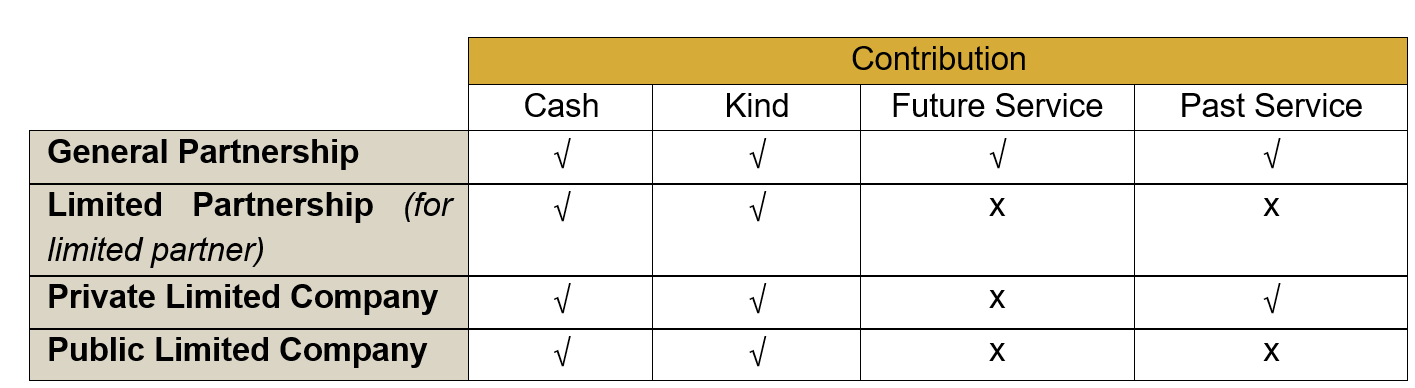
Therefore:
For Dara and Kenji: cash and property can be contributed in any type of business.
For Sophea: whether her work can count as a contribution depends heavily on whether they choose a partnership or a company (see Question 3).
🖊️One point to note: Contribution in services to a partnership
In a general partnership, contributions of knowledge, services or activities are not counted as capital (Article 21). Sophea’s work would entitle her to a share in the business (partnership), but it would not increase the capital figure of the partnership.
Question 2 – Contribution in Kind: Dara wants to contribute his shophouse, and Kenji his espresso machines and brand. What counts as a contribution in kind, and who decides what it is worth?
A contribution in kind is anything other than money or services, which has value to the business. Both partnerships and companies accept it (Articles 16, 21 and 146).
For companies, payment in kind may include “trademarks, copyrights, patents, and the right to use any intangible property” (Article 146).
Kenji’s registered trademark, his espresso machines and Dara’s shophouse therefore qualify as contribution in kind.
Who decides the value?
In a partnership: contributions in kind must be valued, and all general partners must agree to the valuation (Article 21).
In a company: the directors determine the value of a payment in kind or past services, and their decision is final and conclusive unless there is actual fraud (Article 146).
This means Dara and Kenji cannot simply decide the value of their own contributions without the required agreement or valuation process under the applicable rules.
What if the contribution is overvalued?
In a partnership: The LCE does not specifically establish a liability rule for overvaluing a contribution in kind. However, a general partner may be liable to the partnership for damages caused by that partner’s fault under the LCE’s general liability rules.
In a company: Article 140 of the LCE provides a more specific rule. Directors who vote in favor of issuing shares in exchange for non-cash property may be jointly and severally liable to the company for the shortfall if the property is worth less than the amount the company should have received. A director may avoid liability by proving that they did not know, and could not reasonably have known, about the shortfall. A claim must be brought within two years of the resolution authorizing the share issuance.
Agreeing on a contribution's value is not just a matter of trust between business partners. An inaccurate valuation may expose those responsible to liability, depending on the applicable legal rules. Shareholders usually engage external consultants having expertise in the respective areas to provide formal valuation, for e.g., land valuer to value the property.
🖊️One point to note: land and foreign shareholders
Only Cambodian persons and legal entities may own land, and a company can own land only if at least 51% of its shares are held by Cambodian persons or entities (Article 8 and 9 of the Cambodian Land Law). The LCE applies the same requirement of 51% shareholding to determine whether a company has Khmer nationality.
With a 40/30/30 split, Dara and Sophea together hold 70%, so the company could hold the title to the shophouse land. But if Kenji's stake later rises above 49% and decreases the Cambodian partner/shareholders’ share below 51%, the company would no longer be able to own that land.
Question 3 – Contribution in Service: Sophea has no money, only her skills. Can she still become a partner or a shareholder?
In a partnership: yes, as a general partner
Sophea can become a general partner by contributing her services (Article 16). However, there are several rules she and her partners should know:
Continuing obligation (Article 20): a partner who contributes knowledge or activities owes that contribution continuously for as long as he or she remains a partner. Working for the first month is not enough.
No salary (Article 26): no general partner is entitled to wages for working in the partnership business. Sophea is rewarded through her share of the profits, not a salary. If she needs a regular income, the partners should plan for this in the contract, for example by agreeing on regular profit distributions.
Equal sharing by default (Article 24): unless the contract says otherwise, each general partner has an equal share in the assets, profits and losses. If they forget to write down their 40/30/30 split, Dara, Sophea and Kenji would each be entitled to one third, even though Dara contributed a shophouse and Sophea contributed no cash. Further, a clause that excludes a partner from sharing in the profits is not effective (Article 23).
Not as a limited partner (Article 70): if they choose a limited partnership, Sophea must be a general partner (with unlimited liability for the partnership’s debts), because a limited partner cannot contribute services.
In a private limited company: only for past services, but not for future services
Because Article 146 allows shares only for past services, Sophea cannot receive shares today in exchange for a promise to run the café for the next three years. Below solutions may be considered:
Shares for work already done: If Sophea has already completed work before the shares are issued (e.g., designing the menu, building the café’s social media page, recruiting staff), the directors may value those past services and issue shares for them, keeping in mind the directors' liability under Article 140.
A small cash subscription plus earned shares: Sophea pays for a small number of shares in cash now, and a shareholders’ agreement gives her the right to acquire more shares once she meets agreed milestones.
A salary and bonus: Unlike a general partner, a company may employ Sophea as an employee and pay her a salary and performance bonus under an employment contract. This will be treated separately from the dividend from the shares she owns and the terms of her employment should be agreed upfront by all the shareholders.
Question 4 – Fail to Contribute: What happens if a partner does not make the promised contribution, especially Sophea's services?
A contribution is more than a promise between friends. Once the parties agree to it as part of their business arrangement, failing to deliver can have legal and financial consequences.
Partnership
Each partner is a debtor to the partnership for everything he or she promised to contribute (Article 17). If the promised contribution is not delivered, what can the partnership do?
Cash not paid: if Kenji transfers only USD10,000 of his promised USD30,000, he is liable to pay interest from the date the money was due, and the partnership may also claim further damages (Article 19).
Property not delivered: if Dara never hands over the shophouse, he is in breach of his obligation to transfer the property and place it at the partnership’s disposal (Article 18) and must compensate the partnership for damage caused by his fault (Article 27).
Services not performed: imagine that six months after opening, Sophea stops coming to work and opens her own café two streets away. In practice, it is very difficult to force someone to work, so the realistic remedies are financial and an exit:
Compensation: Sophea has breached her continuing obligation under Article 20, and the partnership may claim compensation for the damage caused by her fault.
Handing over profits: under Article 25, a general partner must account to the partnership for any benefits or profits obtained from the partnership’s business or property without the other partners’ unanimous consent, and this obligation cannot be waived (Article 27). If Sophea uses the café’s recipes, customer list or social media page for her new café, the partnership could claim those profits.
Expulsion: Dara and Kenji may, by majority vote, expel a general partner who fails to perform his or her obligations (Article 52).
Note that the LCE contains no express non-compete rule for partners. If Dara and Kenji want to prevent Sophea from opening a competing café, they must put this in the partnership contract.
Company
A company requires a different approach. Article 146 of the LCE, shares must be fully paid for before they are issued. Article 147 addresses a shareholder's liability in relation to the price of the shares subscribed for.
In practice, however, the formal requirement and its enforcement are two different matters. Based on our experience, we have not commonly seen payment of each shareholder’s contribution independently verified by the relevant authorities during incorporation. (This is a practical observation, not an exemption from the legal requirement.)
Therefore, the issue is when the shares have already been issued but the promised contribution has not been made.
The company should not assume that it can simply cancel or take back the shares because a shareholder has failed to deliver the promised contribution. It is worth to note, changing the registered shareholding may also be difficult because the application to the relevant authority may require all shareholders to sign the application form. When a dispute arises, obtaining the necessary cooperation from the other shareholders can be challenging.
Instead, the parties should consider how to address the default through properly drafted constitutional documents and a shareholders’ agreement. Depending on the circumstances, these may include:
requiring the defaulting shareholder to fulfil the outstanding obligation;
providing a mechanism for the sale or transfer of shares following a default, subject to applicable law and enforceability requirements; and
establishing a fair and workable method for valuing shares when a shareholder exits.
So, What Should Dara, Sophea and Kenji Agree on Before Opening the Café?
Before investing their money, property and time, the three founders should agree on key matters:
What each person will contribute: Specify the type, agreed value, delivery date and conditions for each contribution.
How the shophouse will be provided: Decide whether Dara will transfer ownership of the property or grant the business the right to use it.
What happens if someone fails to deliver or leaves: Define each founder’s responsibilities and time commitment, the consequences of default, any appropriate restrictions on competing activities, and the method for valuing a departing founder’s interest.
How foreign ownership affects the business: Consider the implications if Kenji's shareholding increases or the company's ownership structure changes, particularly if the company intends to own land in Cambodia.
⭐The key takeaway: Cambodian law allows business partners to contribute far more than money, including property, intellectual property and even their own work. But each type of contribution comes with its own rules, and the type of business you choose matters. The founders should also decide what happens when a contribution is late, incomplete or never delivered. A clear agreement made before the business opens can help prevent a commercial disagreement from becoming a costly legal dispute.
🚨The information in this article reflects the law as at the date of publication and is for general reference only. It does not constitute comprehensive legal advice. If you need further guidance, feel free to reach out to us at connect@vlplaw.co.